

Bench Scale vs. Lab Scale: Two Meanings, One Clear Answer
The differences between a bench scale vs. lab scale is important to understand to get the proper weighing solution for your situation.
Bench Scale vs. Lab Balance as Weighing Equipment
Here’s the distinction that trips up procurement: a bench scale and a lab scale/balance are optimized for opposite priorities. A bench scale prioritizes capacity, speed, and durability; a lab balance prioritizes readability and precision. Both need calibration; neither does the other’s job.
What a bench scale is built for: A bench scale is a compact, rugged weighing platform for a workbench or table — capacities from roughly 1 lb to 250 lb, readability generally in the 0.1 g to 1 g range. It’s built to shrug off dust, spills, and constant loading in warehouses, shipping and receiving, and food processing. Common jobs are production weighing, portioning, inventory, counting, and checkweighing; dedicated counting scales and checkweighing scales are bench-scale variants tuned for those tasks. Many come as stainless-steel washdown scales (IP65/IP69K) for wet or sanitary lines, and in NTEP legal-for-trade versions where the weight sets a price.
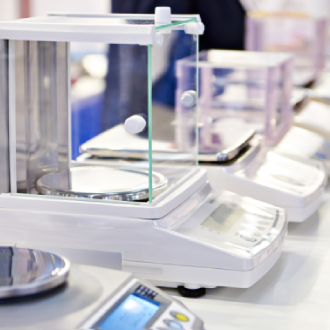
What a lab scale/balance is built for: A lab scale — more precisely a laboratory balance — measures small masses with high precision. Precision balances read to 0.01 g (milligram models to 0.001 g) for routine lab and production QC; analytical balances read to 0.0001 g behind an enclosed draft shield for pharma/QC and research; semi-micro and micro balances go finer still for trace work. Because they resolve micrograms, balances need a still, controlled environment — vibration-free bench, no drafts, stable temperature, a bubble level checked before each session — and higher-end models add internal calibration and USB/Ethernet/LIMS connectivity for GLP/GMP recordkeeping.
The most common buying mistake — confusing readability with accuracy: Readability is the smallest increment the display shows; accuracy is how close the reading is to the true mass. A balance with more decimal places isn’t “better” if your process only needs grams — you’ll overpay and fight environmental sensitivity you don’t need. Match the instrument to the smallest mass difference you must detect and the largest gross load you’ll routinely weigh — then calibrate it, because fine readability on an uncalibrated scale is precision without truth.
Bench Scale vs. Lab Balance: Side-by-Side
|
Factor |
Bench Scale |
Lab Scale / Balance |
|---|---|---|
|
Typical capacity |
~1–250 lb (to 50 kg+) |
~50 g – 12 kg (class-dependent) |
|
Readability |
0.1 g – 1 g |
0.01 g down to 0.001 mg |
|
Priority |
Capacity, speed, durability |
Precision, repeatability |
|
Environment |
Warehouse, dock, food line |
Controlled lab, draft-free, low vibration |
|
Construction |
Painted/stainless steel, washdown options |
Draft shield, leveling feet, sensitive weighing cell |
|
Typical uses |
Shipping, portioning, inventory, counting, checkweighing |
Formulation, assay, pharma/QC, research |
|
Data / features |
Counting, checkweigh, NTEP legal-for-trade |
Internal calibration, USB/LIMS, GLP/GMP docs |
|
Relative price |
Lower per unit |
Higher for equivalent capacity |
How to Choose Between a Bench Scale and a Lab Balance
Bulky product, cartons, or containers where speed and toughness matter: Bench scale. Add washdown stainless steel for wet or food lines, and NTEP certification if the weight sets a price.
Small samples where milligram (or finer) precision drives the result: Lab balance — a precision balance for routine work, an analytical balance with draft shield for QC and research.
Counting parts or checking fill weights at volume: A counting scale or checkweighing bench scale, not a balance.
Not sure where your tolerance really lands: That’s a calibration and application question — ask before you buy. Whichever you choose, calibration is non-negotiable: it’s what keeps a bench scale honest on the production floor and a balance trustworthy in QC. AAA Weigh’s ISO/IEC 17025:2017-accredited lab provides on-site calibration and repair service for everything from micro-balances to truck scales.
Frequently Asked Questions About Bench Scales vs. Lab Scales
What is the difference between a bench scale and a lab scale?
A bench scale is a rugged, higher-capacity weighing platform (roughly 1–250 lb, 0.1–1 g readability) for production, shipping, and inventory. A lab scale — a laboratory balance — is a precision instrument (0.01 g down to 0.001 mg) for small, exact measurements in QC and research. Bench scales prioritize capacity and durability; balances prioritize readability and precision. AAA Weigh stocks both across its 5,300+ SKUs and can match the instrument to your tolerance.
Is a bench scale the same as a balance?
No. They’re often confused, but a balance offers far finer readability and needs a controlled, draft-free environment, while a bench scale offers higher capacity and rugged construction for everyday industrial use. If you’re unsure which your application needs, AAA Weigh’s team will ask about your samples and tolerances before recommending either.
What does “bench scale” mean in process development?
It’s the earliest, smallest experimental stage — milliliters to a few liters — where a process is proven for feasibility before moving to pilot scale and then commercial scale. In that context, “bench scale” and “lab scale” mean the same thing; the equipment distinction in this guide applies when you’re buying a weighing instrument.
What is an analytical balance and when do I need one?
An analytical balance reads to 0.0001 g (0.1 mg) and has an enclosed draft shield to block air currents. Use one for pharmaceutical QC, assay, and research where micro-level accuracy matters; if grams are enough, a precision balance or bench scale is the better value. AAA Weigh carries analytical and precision balances from Ohaus, Sartorius, and A&D.
Do bench scales and lab balances both need calibration?
Yes. Both drift over time and with use, and fine readability doesn’t survive an audit without traceable records. AAA Weigh’s ISO/IEC 17025:2017-accredited calibration lab services both — on-site across Southern California or in-house — with certificates that satisfy ISO 9001 and customer audit programs.
Can I use a bench scale in a lab, or a balance on the production floor?
You can, but each fights its environment: a bench scale lacks the readability for analytical work, and a balance on a vibrating production floor will never settle to a stable reading. Put the bench scale where durability and speed matter and the balance where precision and stillness do — AAA Weigh can spec both ends of that line from stock.
Shop Bench Scales and Lab Balances at AAA Weigh
AAA Weigh has supplied, serviced, and calibrated weighing equipment for Southern California manufacturers, labs, and QC departments for 47 years. We stock rugged bench scales, washdown checkweighers, and precision and analytical laboratory balances from Ohaus, Sartorius, and A&D at our San Fernando and Ventura locations — over 5,300 SKUs — and because we run an ISO/IEC 17025:2017-accredited calibration lab with our own technicians, we support every instrument we sell for its whole working life.
If you’re not sure whether your application calls for a bench scale or a balance, our team will ask about your samples, tolerances, and environment and recommend the right capacity and readability the first time — no guesswork, no dropship lead times.
Browse Bench Scales and Laboratory Balances, or click here to contact us for more information.

NEWSLETTER SUBSCRIPTION
Subscribe to our newsletter to receive special updates, news and promo codes for discounts!
 AAA Weigh is an ISO/IEC 17025:2017 & ANSI/NCSL Z540-1-1994 Laboratory (AC-1422). Our process of calibration has been reviewed by ANAB and our test weights, documentation and testing processes are proven and traceable.
- Choosing a selection results in a full page refresh.
- Opens in a new window.